|
The
Lovells
of Titchmarsh
From Ivry-la-Bataille to the Battle of Stoke
|
|
|
|
|
Titchmarsh
Castle
Old Warour Castle
Minster Lovell Hall
Other Lovell Castles
Francis,
Viscount Lovell and Sir Thomas Lovell
|
From
1995 to 1999 I was the Lovells of Titchmarsh, a late
medieval baronial family
at the University of York for my DPhil thesis.
The Lovells of TItchmarsh are not widely known and the one man
who has achieved some fame,
Francis, Viscount Lovell, close ally and friend of Richard III,
is at the same time the last Lord Lovell of Titchmarsh. With his
disappearance after the battle of Stoke in 1487 the main line of
the family died out. Despite their relative obscurity, the
Lovells were a fascinating subject to study. For four hundred
years they were deeply involved of English history. From the
third crusade to the battle of Stoke, there are few major
historical events were not one Lovell was involved.
This is a very brief summary of the family's history. I hope to
add more and discuss a few specific events or details of their
history in due time.
[Note: Like most medieval families the Lovells had a penchant
for specific names. In their case it was William and John. To
keep the various heads of the family apart, they are numbered.]
|
|
| Did
Francis Lovell have Children? |
|
|
Francis
Lovell as
Protagonist in Historic
Novels
William
de Breteuil
The
Great Lord Lovell?
|
Like
most
aristocratic families in post-1066 England, the Lovell family was
originally from Normandy. Their earliest traceable ancestors were
somehow linked to the border castle of Ivry, nowadays called
Ivry-la-Battaille. The first member of the family who made an
impact on history was Ascelin Goël (d.
1115-1119). He was embroiled in a long and violent quarrel with
William de Breteuil about the possession of the castle of Ivry.
His sons, Robert Goël and William Lovell I, were participating in
some of the rebellions that disturbed the duchy in the reign of
Henry I. It was William Lovell I who first received lands in
England, notably in Southmere and Docking (Norfolk). |
|
|
|
|
|
William
Lovell I probably divided his estates between his eldest son,
Waleran d'Ivry, who inherited the family's Norman possessions, and
William Lovell II, whose share encompassed the lands in England.
William Lovell II probably joined Richard I's crusade, but it is
unknown how long he was abroad. In 1201, he was among the
aristocrats who refused to serve in France.
After his death, probably in 1212, his son John Lovell I became a
ward of Alan Basset, an important follower of King John. Alan
Basset married his daughter Katherine to John Lovell I. Only a few
details are known about the life of John Lovell I. He seems to
have joined the baronial opposition to King John in 1216, as his
estates were declared forfeit. He must have received them back
soon afterwards as they were again declared forfeit in 1223, when
John Lovell I refused to join the campaign against Llewelyn ap
Iorwerth. Three years later, he participated in the siege of
Bedford Castle.
|
|
|
|
|
|
John
Lovell
I's younger brother, Philip Lovell, first entered the service of
Roger de Quency, Earl of Winchester. He later served King Henry
III as Justice of the Jews and later became Treasurer of England.
He was, however, dismissed in disgrace in 1258. Nonetheless, his
service was no doubt one of the reasons why his nephew John Lovell
II became closely involved with the royal court. Another link was
provided by the Basset family. Fulk Basset, Katherine Basset's
brother, was bishop of London. Another brother, Philip Basset, was
Justiciar. John Lovell II, like his Basset relatives, was a
royalist during the Barons' War. He was taken prisoner at the
Battle of Lewis and was forced to let some of his properties to
pay his ransom.
How important the connection to the Bassets was can be seen from
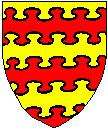
the fact that the Lovell coat of arms, barry
nebuly or and gules, is a variation of the Basset coat of
arms, barry undy or and gules.
In fact, the Lovells also used the latter variation of the arms. |
|
|
The coat of arms of the Lovells of Titchmarsh
|
|
|
John
Lovell
II married Maud de Sydenham, who brought the manor of Titchmarsh
to the family. John Lovell II helped raise money for the crusade
of the Lord Edward, soon to be Edward I, and made preparations to
join the crusade. Though there is no record that confirms he
participated in the campaign, his complete absence from government
record for several years makes it more than likely.
John Lovell III, eldest son of John Lovell II and Maud Sydenham,
participated regularly in the various campaigns during the reign
of Edward I in Wales, Scotland, and on the continent. From 1296,
he received individual summonses to parliament. At the time, the
group of noblemen who received individual summonses to parliament
had not become a separate class
yet and there was considerable variation in the men who
were summoned from one parliament to the next. Though John Lovell
III is the first Lord Lovell, this did not fundamentally
change his status.
John Lovell III married twice. His first wife was Isabel du Bois.
Their only child, Maud, inherited the du Bois estates in 1313.
Joan de Ros, John Lovell III's second wife, was the mother of his
sons John Lovell IV and William Lovell. |
|
|
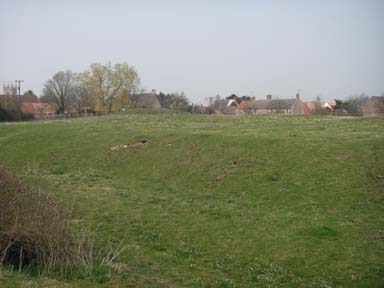
The grounds where Titchmarsh Castle once stood
|
|
|
John
Lovell
IV married Maud Burnell, who was the great-niece of Robert
Burnell, bishop of Bath and Wells, and Chancellor under Edward I.
John Lovell IV and his brother William were both in the service of
Aymer de Valence, earl of Pembroke. Together with their lord they
participated in the disastrous campaign against Robert the Bruce
in 1314. John Lovell IV was killed in the battle of Bannockburn on
24 June 1314 and his younger brother was captured.
Maud Burnell soon married the widowed Sir John Haudlo. Her brother
Edward had died and Maud had inherited the considerable Burnell
estates. She and her second husband arranged for most of the
inheritance to pass to their son, Nicolas Burnell. Only after the
death of Nicolas Burnell's son Hugh Burnell without male hairs,
the bulk of the Burnell estates passed to William Lovell III.
|
|
|
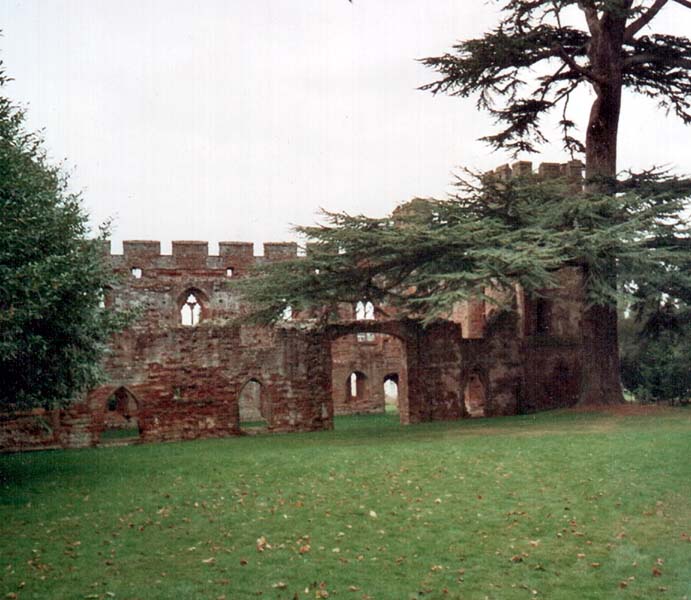
Acton Burnell Castle - part of Maud Burnell's large inheritance
|
|
|
Aymer
de Valence became the guardian of John Lovell IV's posthumous
son, John Lovell V. After Aymer de Valence's death, his widow,
Mary de St Pol, had to return the wardship of John Lovell IV to
Edward II. It is unknown who eventually arranged John
Lovell V's marriage and the identity of his wife is also
uncertain. She may have been Isabel de la Zouche. If that was
the case, she was the granddaughter of Maud Lovell, daughter of
John Lovell III and Isabel du Bois.
John Lovell V never received an individual summons to
parliament. He was therefore, strictly speaking, no longer a
member of the parliamentary peerage. John Lovell V, fought in
Scotland and also in the battle of Crécy and took part in the
siege of Calais. He died in 1347. It is possible that he was
murdered, as a few years later, several 'evildoers' were held in
Norwich jail indicted in the murder of John Lovell.
|
|
|
|
|
|
John
Lovell
V had two sons who were both called John. John Lovell VI died in
1363 still underage. His younger brother, John
Lovell VII, restored the family's fortunes. His success had
two reasons: First, he married Maud Holland, granddaughter and
heiress of Robert Holland, whose younger brother was the first
husband of Joan of Kent, who later married Edward 'the Black
Prince'. His marriage therefore created a relationship, albeit an
indirect one, with the royal family. The Holland estates were very
large and approximately doubled the lands the family held. To
commemorate this union, John Lovell VII not only used as his coat of
arms the Lovell arms quartered with the Holland arms but also styled
himself 'Lord Lovell and Lord Holland'. |
|
|
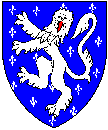
The coat of arms of the Holland family |
|
|
The
second reason for his success was John Lovell VII's heavy
involvement in the royal court. He began his career as a courtier in
the last years of Edward III's reign, was first summoned to
parliament in 1375. Until shortly before his death in 1408 John
Lovell continued to work at the centre of government. That his
presence at court not only made him friends can be seen from the
fact that John Lovell VII was among the men and women expelled from
court in 1388. After the usurpation of Henry IV, John Lovell VII was
considered as tutor for the future Henry V, but failed to get the
appointment. In 1405 he became a Knight of the garter.
John Lovell VII built a new castle at Wardour.
While it was severely damaged during the English Civil War, the
ruins are still impressive. It is of an unusual, hexagonal style.
Thanks to the survival of a part of a book he commissioned, the
Lovell Lectionary, we also have a portrait of John Lovell VII. It is
one of the earliest pictures that have portrait-character in
England. (Other portraits exist of Geoffrey
Chaucer and Richard II). |
|
|
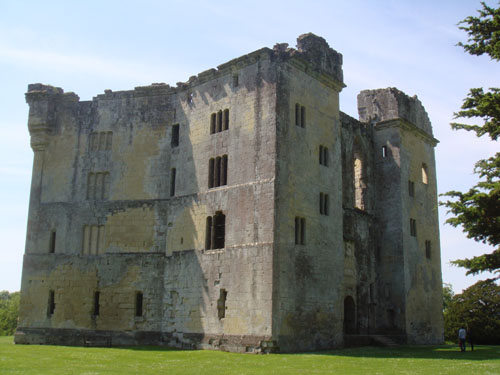
Wardour Castle
|
|
|
John
Lovell
VIII, the eldest son of John Lovell VII, died only six years after
his father in 1414. His wife was probably Eleanor de la Zouche,
though she cannot be identified with certainty.
His younger
brother, Robert Lovell, was married to Elizabeth Bryan, whose
grandfather Guy Bryan had been an important courtier in the reign
of Edward III. Robert Lovell was well acquainted with Prince
Henry, the future Henry V, with whom he went on campaign in Wales
and who at least on one occasion used Robert Lovell's house in
London to meet with the royal council. Possibly, Robert
Lovell was one of the young men whose rowdy ways infuriated the
old king. Robert Lovell lent Henry V considerable amounts of money
which he failed to regain, despite petitioning repeatedly. He died
bankrupt and his goods were seized. Nonetheless, as the sole
heiress of the Bryan estates his daughter Maud Lovell married
well. Her first husband was Humphrey Stafford with whom she had a
daughter, Avice. Her second husband was John Arundel with whom she
had a son, named like her first husband Humphrey, who died in
infancy. |
|
|
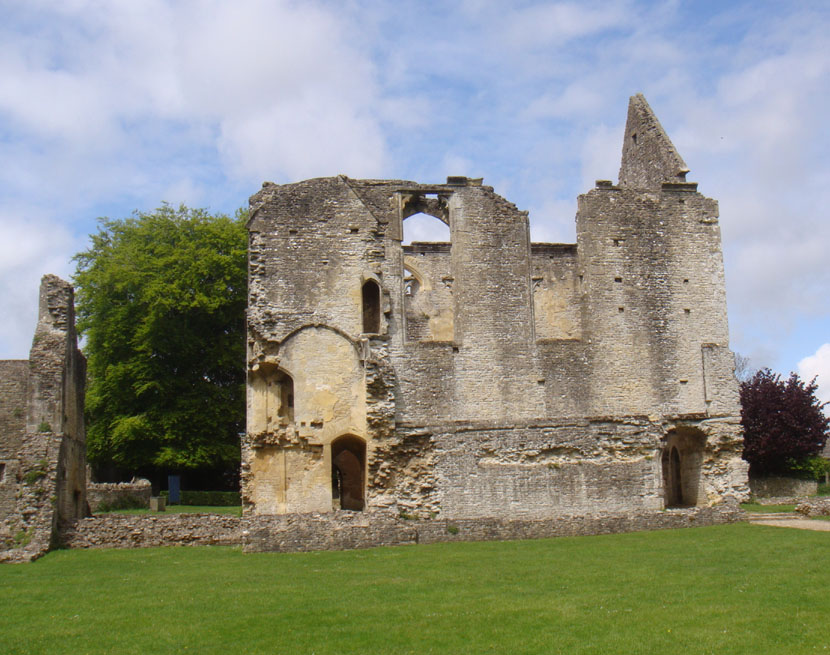
Minster
Lovell Hall - favourite residence of William Lovell III
|
|
|
William
Lovell
III was underage at the time of his father death and his marriage
was granted to Henry FitzHugh of Ravensworth. Henry FitzHugh
probably arranged the marriage of his ward to Alice Deincourt, one
of the coheiresses of the Deincourt and Grey of Rotherfield
baronies. Her sister Margaret married Ralph Cromwell, but as they
had no children, Alice Deincourt eventually inherited her sister's
share of the baronies as well.
William
Lovell III spent some of his younger years in France, where the
Hundred Years' War was still dragging on. He was, however, unlike
his grandfather or his brother-in-law Ralph Cromwell, not very
active in politics. He seems to have preferred a quiet life. He
died in 1455. |
|
|
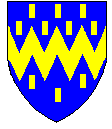
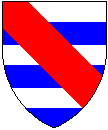
The
coats of arms of the Deincourt family (left) and the Grey of
Rotherfield family (right) |
|
|
John
Lovell
IX was William Lovell III's eldest son and, unlike his father, he
became heavily involved in national politics. At this time, the
opening years of the Wars of the Roses, it became increasingly
difficult to stay aloof of partisan politics. He was married to
Joan Beaumont and like her father, John, viscount Beaumont, John
Lovell IX supported Henry VI, choosing the Lancastrian side over
the Yorkist one. Together with his father-in-law he tried,
unsuccessfully, to defend London against the Yorkists and also
fought on the Lancastrian side at the Battle of Towton. However,
he made his peace with the new king, Edward IV. He died in 1465,
leaving a minor son and two daughters. |
|
|
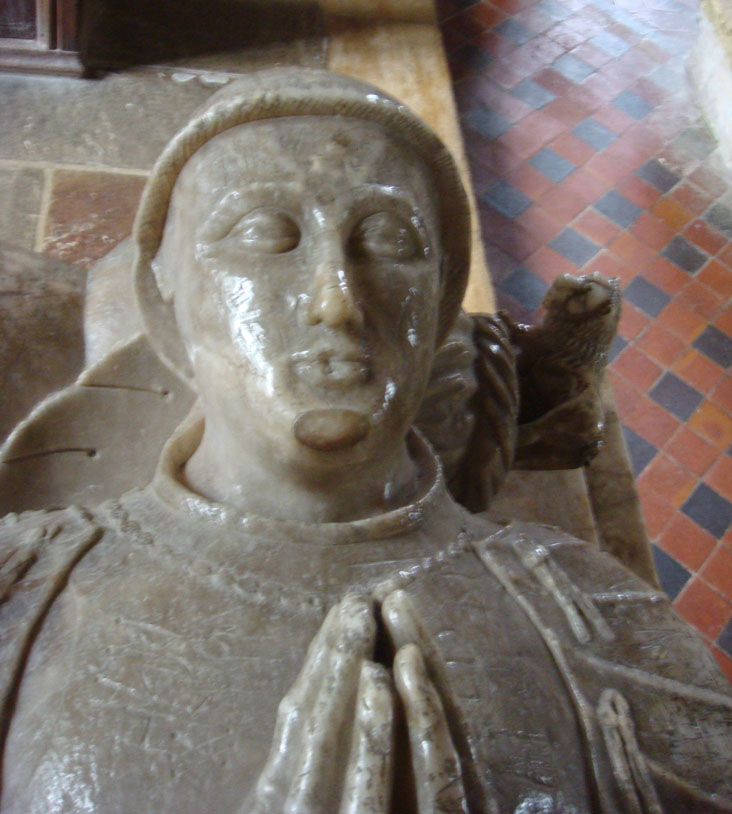
Tomb of John Lovell IX in St Kenelm's Church
|
|
|
In
a
startling break from family tradition, John Lovell IX's son and
heir was not another John. It seems that John Lovell IX and his
wife Joan Beaumont had a penchant for unusual names. While one of
their daughters was named Joan, either after her mother or to
satisfy family tradition, their second daughter and only son were
given very different names. Their son was called neither John nor
William, nor even Robert or Thomas, the names often given to
younger son, but Francis. Their second daughter was named
Frideswide. St Frideswide was one of the notable saints of Oxford,
where an Augustinian priory stood (now Christchurch Cathedral).
As Francis Lovell was a minor when his father died, his wardship
was granted to Richard Neville, earl of Warwick. Francis Lovell
was married to Richard Neville's niece, Anne FitzHugh. He did move
to his guardian's castle of Middleham, but it is not known whether
he became acquainted with Richard, duke of York at this stage, as
it is possible that Richard had already left the earl of Warwick's
care at this time. |
|
|
|
|
|
Though
it is unknown when exactly Francis Lovell first met Richard, duke
of York, by the later 1480s Francis had become one of Richard's
close companions and participated in several of the duke of
Gloucester's campaigns, for example to Scotland in 1480. On 4
January 1483 Francis Lovell was created viscount by Edward IV.
While he certainly was wealthy enough to support the status, his
friendship with Richard, duke of Gloucester was the main
reason for his elevation into the titled ranks of the nobility.
After
Edward IV's unexpected death on 9 April 1483, Francis Lovell was
one of the men Richard, duke of Gloucester employed in the brief
time he was Lord Protector for the young Edward V. |
|
|
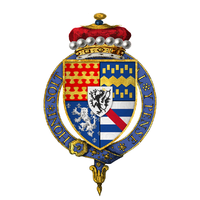
Coat
of arms of viscount Francis Lovell, Knight of the Garter
|
|
|
When
Richard
decided to claim the throne shortly afterwards, Francis Lovell,
naturally, remained one of the most important man at court. He
became Chief Butler and Lord Chamberlain. The position Lord
Chamberlain was one of great importance, as he regulated the
access to the king and therefore not only had to be in constant
attendance at court but was
also always a man whom the king could trust implicitly.
Several holders of this office, notably William Latimer in the
last years of Edward III, had raised strong opposition by the way
they used their influence. Despite this high position in Richard
III's government there is very little we know about Francis
Lovell
personally. He remains, as one of his biographers wrote, 'a
shadowy presence'. While it is dangerous to argue from negative
evidence, the sparsity of traces Francis Lovell left indicates
that he did not abuse his position. The notable exception is the
famous doggerel by William Collingbourne which is a very vague,
general derogatory remark about Richard III's reign, naming three
of his most important supporters, namely Francis Lovell,
William Catesby and Richard Ratcliffe but does not provided
specific accusation against either of them. Richard III also made
Francis Lovell a Knight of the Garter.
The reign of Richard III ended just after a little over two years.
Francis Lovell almost certainly participated in the climactic
battle at Bosworth and was wrongly counted among the dead in the
immediate aftermath. He spent a considerable time in hiding and
tried, unsuccessfully, to kidnap Henry VII at York in the spring
of 1486. In the following year he was among those who supported
the rising in favour of Edward, earl of Warwick, though the young
man crowned in Dublin. The identity of this young man is unknown
but he is generally believed to have been an imposter, known to us
as Lambert Simnel. Francis Lovell fought at the battle of Stoke
but went missing afterwards. Several theories
exist about his fate. The last official record is a safe conduct
James IV granted to him in 1488. What happened to him after this
date is unknown.
|
|
|
|
|
|
With
his
disappearance, the Lovells of Titchmarsh became extinct.
Only two years later, when his cousin, Henry Lovell, Lord Morley
was killed in the battle of Dixmunde, the family became extinct in
the male line. Francis Lovell had been attainted and the attainder
was repeated in parliament in 1495. Though it specifically stated
that the rights of his wife Anne FitzHugh were not to be affected,
the estates that had been part of her endowment had already been
granted to supporters of Henry VII and there is no evidence that
she was able to regain any of them. The date of Anne FitzHugh's
death is not known.
|
|
|
For
a more detailed discussion of the fascinating history of the
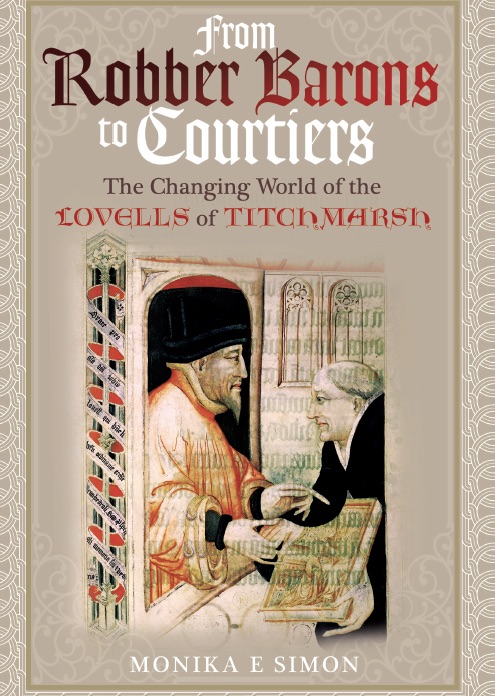
Lovells of Titchmarsh and beyond see also my book: From
Robber Barons to Courtiers. The Changing World of the Lovells
of Titchmarsh (Pen & Sword Books, 2021).
|
|
|
Monika E. Simon, 'The Lovells of Titchmarsh. A Late Medieval
Baronial Family (1297-148?)', (unpubl. DPhil Thesis, University of
York, 1999). |
|
|
©
Monika E. Simon
© Heraldry Gill
Smith, Glossary
of Heraldic Terms.
|
|
|
|
|
|
e-mail:
info@monikasimon.eu |
|
| Return
to Home |
|
|