|
Titchmarsh
Castle |
 |
|
|
|
The
Lovells
Minster Lovell Hall
Old Wardour Castle
Other Lovell Castles
Francis,
Viscount Lovell und Sir Thomas Lovell
The Great Lord
Lovell?
|
The
Lovells
of Titchmarsh first held only a few estates in England. Over time
and as the result of several very fortunate marriages, they
acquired considerable estates all over England.
Three places in particular are connected with the family, Minster
Lovell (Oxfordshire), Old Wardour Castle (Wiltshire) and
Titchmarsh (Northamptonshire),
the place the family was named after
to differentiate them from other families of that name, as for
example the Lovels of Castle Cary.
The
first Lovell residence I visited was, unsurprisingly, the place
that is most obviously connected with the family, Minster
Lovell
Hall. Some years later, in 2005, I also went to see Old
Wardour
Castle. Both are reasonably well-known, if ruinous, castles
and today under the care of English Heritage.
It is perhaps not surprising that Titchmarsh was the last of the
main residences I visited. Unlike in Wardour and Minster Lovell
Titchmarsh castle has completely disappeared. |
|
| Did
Francis Lovell have Children? |
Castle
Grounds
at Titchmarsh |
|
|
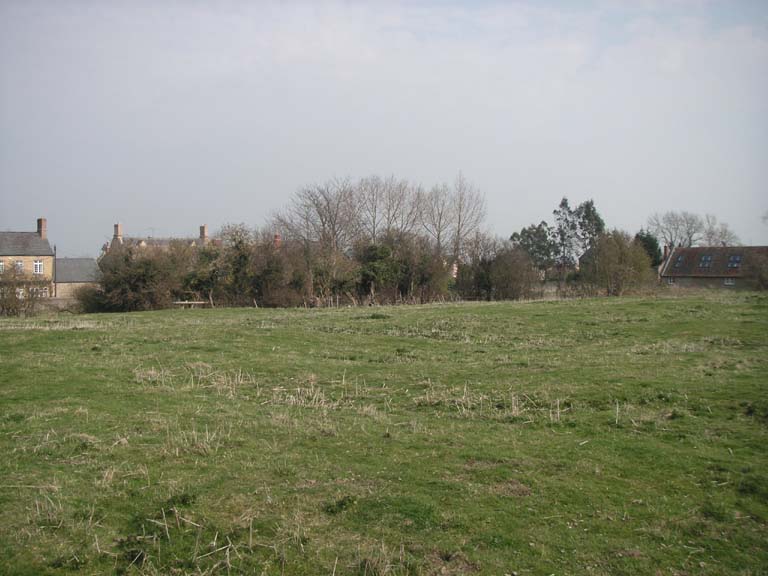
As
the picture shows, there is not really much to see where the
castle once stood, but at least the ground has not disappeared
under a housing project. Today it serves as pasture. That a castle
or manor house used to stand on this site was well known and
stones found there were reused for building purposes over the
centuries. In 1887, the owner of the lands, Lord Lilford,
instigated that the area was properly examined and a thorough
archaeological excavation took place.
In 2007, my friends and I,
armed with a plan from this excavation,
went exploring the area. |
|
|
Remains
of the southern ditch |
|
|
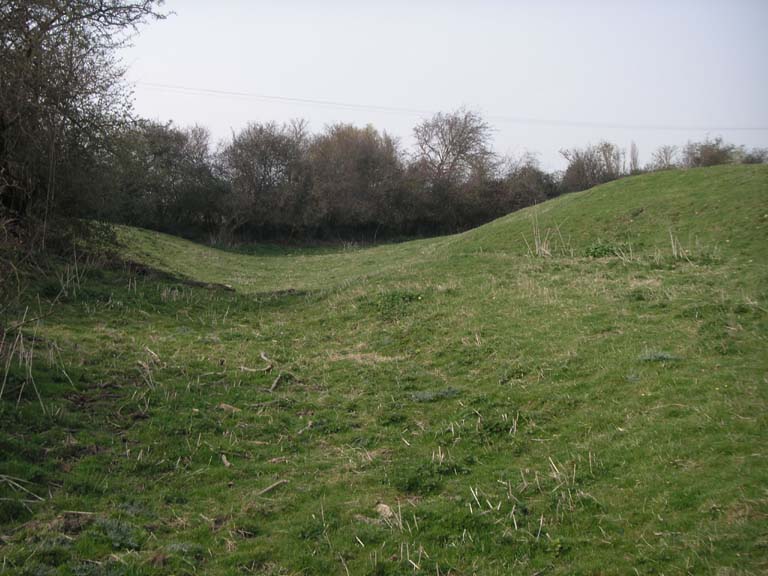
Most
of
the structures found in 1887 are now again grassed over. How much
of the walls are still there is another question. During the
excavation some of the walls discovered were still eight feet in
height. They ran along the entire length of the ditches. (This
picture shows the ditch on the south side of the castle. The wall
is on the right.)
The excavation discovered remains of two distinct building
periods. Of the earlier and smaller building no visible sign
remains above ground. As John Lovell III received a licence
to crenellate his manor house at Titchmarsh in 1304 the newer
building was probably built in the years following. A larger area
was enclosed with walls and a ditch.
|
|
|
Some
stones peeking out of the ground |
|
|
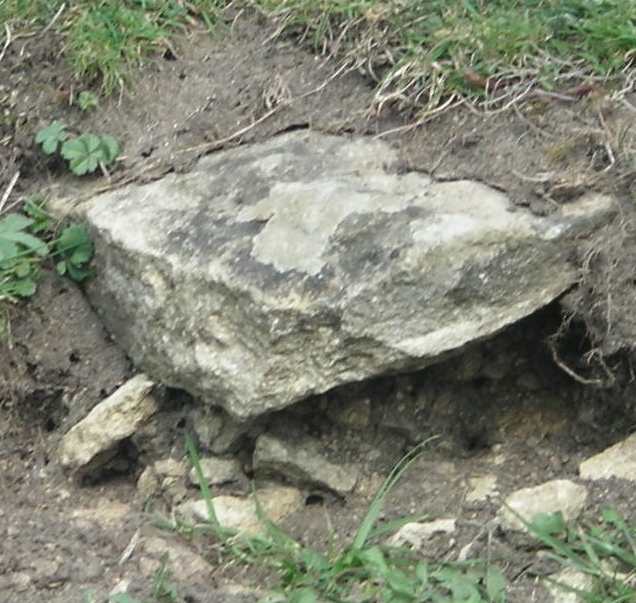
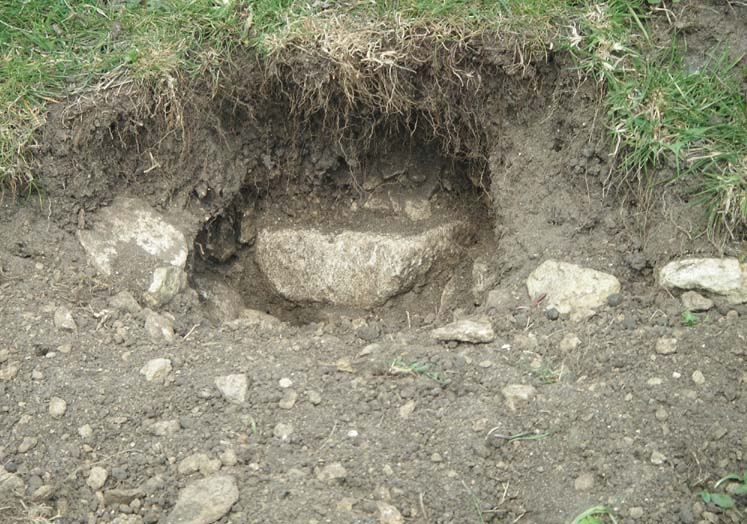
Some
stones of the wall surrounding the castle can be seen at the side
of the ditch. The reason for their exposure is presumably the
cattle grazing there. The stones were probably quarried at Weldon. |
|
|
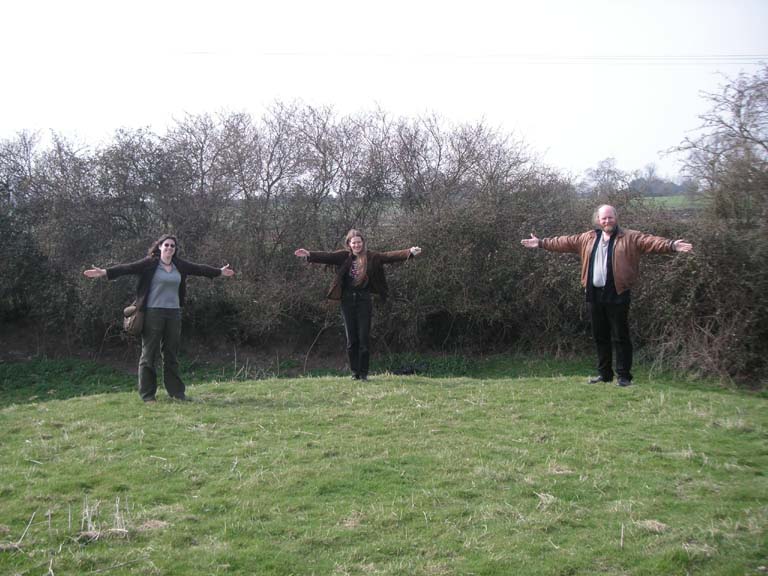
Site
and size of the multiangular tower at the south-western corner
of the castle |
|
|
At
each corner of the walls were multiangular towers, though only
three could be located during the excavation. They must have added
to the warlike appearance of the castle. (On
this picture my friends demonstrate the size and location of one
of the towers.) The
distance
between the towers is roughly between 220 and 257 feet (or 67m to
78m). While by no means a huge castle even at the standards of the
time it was no doubt impressive. |
|
|
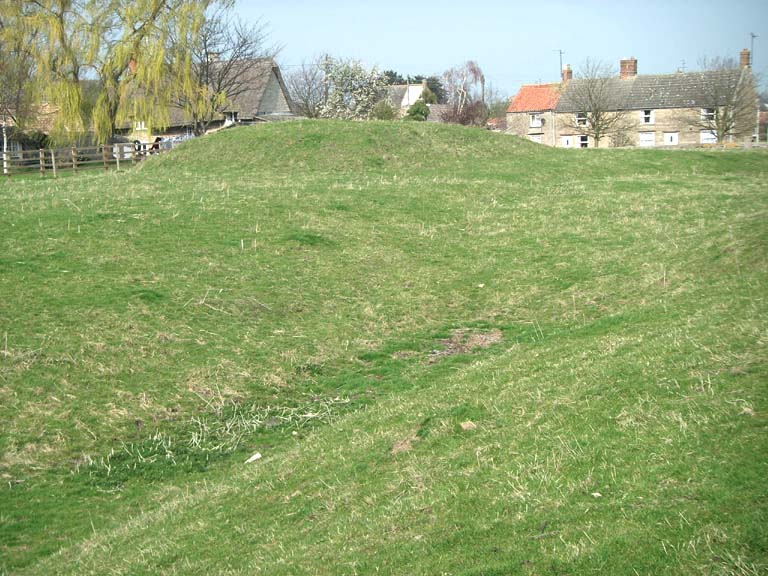
Remains
of west ditch and Chapel Hill |
|
|
Outside
the area of the proper fortifications,
on the north-western side, lies this small hill, which may have
been the site of a chapel. If this is true, the chapel must have
been pretty small. |
|
|
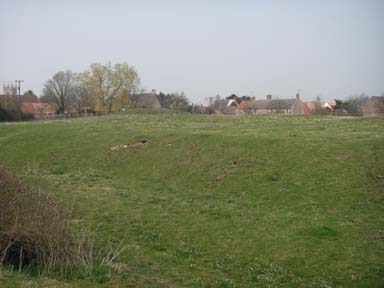
View
over Castle Grounds |
|
|
An
interesting
fact is that apparently the castle was already in a state of
disrepair in 1361, not even 60 years after John Lovell III
received licence to rebuilt the castle in a grander and more
elaborate style. The most likely explanation seems to be that the
building was allowed to fall into disrepair during the long
minorities between the, possible violent, death of John Lovell V
in 1347 and the coming of age of his younger son John Lovell VII
in 1363 (his elder brother was John Lovell VI). Perhaps the plague
which ravaged the country in 1348 also played a part.
Additionally, John Lovell V seems to have already sublet the
castle and preferred to reside in Minster Lovell, while his son's
favourite residence was Wardour Castle.
After the battle of Bosworth
In 1485 Francis Lovell was attainted, and Titchmarsh granted to
Charles Somerset. At some time afterwards, the castle, or what
remained of it, was torn down and the fabric used to built
Titchmarsh Manor which in turn was already deserted by the reign
of Elizabeth I.
Titchmarsh Castle may today be not much to look at, but I am very
glad I visited it. |
|
|
Sources:
Dryden, H.E.L., ‘The Castle of Tichmarsh, Northamptonshire’, Associated
Architectural Societies, Reports and Papers 21 (1891),
248-52.
Simon, M.E., 'The Lovells of Titchmarsh. A Late Medieval Baronial
Family (1297-148?)', (unpubl. DPhil Thesis, University of York,
1999).
Taylor, A.J., Minster
Lovell Hall (Oxfordshire) (Ministry of Works, London,
1947). |
|
| Return
to Home |
©
Monika E. Simon |
|